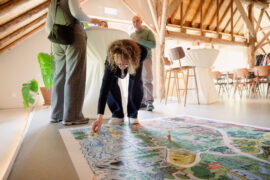
The day kicked off with a so-called ‘warm data lab’, facilitated by Marije Bosch. In small groups, participants reflected on questions around the health transition. By regularly switching groups, they were exposed to new questions and different people each time, gradually building a richer understanding of the complexity at hand.
This was followed by two keynotes. Paul Beenen introduced the NEST project and reflected on what it means to work in times of transition. Together with colleagues, he developed a booklet on this topic called ‘The art of working in transitions’, which he presented to the audience. This booklet offers some key principles and concepts for anyone who aims to work or is already working in societal transitions.
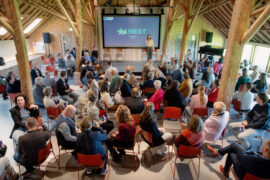
Thomas Plochg (Federatie voor Gezondheid) then invited participants to rethink health altogether with his keynote. With the Investment Strategy, he reframed health not as a cost, but as something that creates value for society.
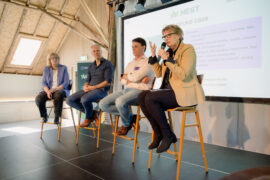
The morning concluded with a panel discussion featuring Ester Lohuis (Cadanz Welzijn), Nienke de Vries (elderly care specialist at De Hoven), Paul Beenen and Thomas Plochg. Together, they reflected on the key insights of the morning and what these mean in practice.
Getting to work
In the afternoon all of the participants got hands-on experience through a series of workshops. In one of the sessions they explored how to involve citizens in societal challenges, research and policy in a meaningful way.
Another workshop took participants into the ‘interprofessional learning ward in Eemsdelta’. Here, they learned how professionals, educators and organisations collaborate in practice and what is needed to scale this up. And in a third session, participants worked with reflexive monitoring: a flexible approach to monitoring that fits the dynamic nature of social innovation and transition processes.
Rounding up
We closed the day with drinks and bites: a chance to reflect, continue conversations and connect.